Buying Backpacks in Bulk: Complete Buyer's Guide for 2026
Buying backpacks in bulk transforms the economics of retail, corporate gifting, and organizational purchasing. Instead of paying retail prices ($40-80 per unit), bulk buyers access wholesale pricing ($8-25 per unit), unlocking 150-200% profit margins for retailers or significant cost savings for corporate buyers. But bulk purchasing isn't simply placing a large order—it's a strategic process involving supplier selection, volume negotiations, quality assurance, inventory management, and ROI calculation. This comprehensive guide reveals everything you need to know about buying backpacks in bulk, from understanding volume tiers to maximizing profitability.
Understanding Bulk Backpack Pricing and Volume Tiers
Bulk pricing works on a tiered system. The more units you order, the lower your per-unit cost. However, the discount structure varies significantly by supplier and product. Understanding these tiers is crucial for calculating true ROI.
Typical Bulk Pricing Tiers
| Order Volume | Per-Unit Cost | Total Investment | Typical Lead Time | Best For |
|---|---|---|---|---|
| 50-100 units | $18-25 | $900-2,500 | 2-4 weeks | Testing, small retail, starter orders |
| 100-250 units | $14-20 | $1,400-5,000 | 3-6 weeks | Small retailers, online sellers |
| 250-500 units | $12-18 | $3,000-9,000 | 4-8 weeks | Multi-location retail, mid-size e-commerce |
| 500-1,000 units | $10-15 | $5,000-15,000 | 6-10 weeks | Established retailers, corporate buyers |
| 1,000-2,500 units | $8-12 | $8,000-30,000 | 8-12 weeks | Large retailers, regional distributors |
| 2,500+ units | $6-10 | $15,000+ | 10-16 weeks | National retailers, major corporate orders |
Key Insight: The pricing drop from 50 units to 500 units is dramatic (25% to 12% = 52% cost reduction). But the drop from 500 units to 2,500 units is modest (12% to 6% = 50% cost reduction). The biggest savings come at the 250-500 unit range. Calculate your sweet spot—the volume that maximizes savings while minimizing inventory risk.
Why Bulk Buying Creates Competitive Advantage
For Retail Businesses
Superior Margins
Buy at $12, sell at $45-60. 200%+ margins fund store operations, salaries, marketing, and profit. Budget retailers stuck at 25-35% margins cannot compete.
Pricing Flexibility
Low per-unit costs allow competitive pricing. You can undercut competitors by 10-15% and still maintain healthy margins, driving customer acquisition.
Inventory Control
Buy strategically based on seasonal demand. Stock heavily during peak season (back-to-school), lightly during slow season. No forced inventory.
Supplier Relationships
Bulk commitments attract supplier attention. Access to new products, exclusive designs, trend insights, and priority service unavailable to small buyers.
For Corporate and Institutional Buyers
Cost Per Unit Reduction
Corporate gifts, employee programs, and promotional items cost 50-70% less through bulk purchasing versus retail. 500 backpacks for $6,000 vs. $20,000 retail.
Branding Customization
Bulk orders unlock customization: company logos, custom colors, branded packaging. Create corporate identity and enhance brand perception.
Budget Efficiency
Stretch allocated budgets further. $50,000 corporate gift budget purchases 2,500 quality backpacks (bulk) vs. 625 retail units. Impact and perception multiply.
Standardization
Ensure all recipients get identical quality products. Bulk purchasing guarantees consistency across entire distribution—no variations between units.
The True Cost of Bulk Backpack Purchasing
Unit price is just one component. Understanding total cost requires calculating all hidden expenses.
Complete Cost Breakdown Example
Scenario: Ordering 500 backpacks at $15/unit from international supplier
Unit Price (500 × $15):
$7,500
Shipping (Ocean Freight):
$1,000
Import Duties (10%):
$750
Customs Clearance:
$150
Local Delivery/Trucking:
$300
Quality Inspection Labor:
$100
Cargo Insurance:
$75
Packaging/Labeling:
$200
TOTAL LANDED COST:
$10,075
Cost Per Unit:
$20.15
Notice: Your "$15 per unit" backpacks actually cost $20.15 per unit once all expenses are included. This changes your margin calculation significantly.
⚠️ Common Mistake: Retailers calculate margins based only on unit price ($15) and planned retail price ($49.99), expecting 233% margin. But actual margin is only 148% ($49.99 - $20.15 = $29.84 profit per unit). Hidden costs collapse margins by 36%.
How to Calculate ROI on Bulk Backpack Purchases
Step-by-Step ROI Calculation
1Calculate Total Investment
Total landed cost (from calculation above): $10,075 for 500 units
2Determine Retail Price
Research market pricing. For $20.15 cost backpack: competitive retail price is $45-55. Use $49.99 for calculation.
3Calculate Gross Profit Per Unit
Retail Price ($49.99) - Total Cost Per Unit ($20.15) = $29.84 gross profit per unit
4Estimate Sales Velocity
How many units sell per month? Conservative estimate: 50 units/month (based on store traffic, online sales, market research)
5Calculate Payback Period
Total Investment ($10,075) ÷ Gross Profit Per Unit ($29.84) = 337 units to break even = 6.7 months of sales
6Calculate Annual ROI
Annual Units Sold (600 at 50/month) × Gross Profit Per Unit ($29.84) = $17,904 annual gross profit
ROI = ($17,904 - $10,075) ÷ $10,075 = 77.7% annual ROI
Result: Ordering 500 backpacks generates $17,904 annual gross profit with 77.7% ROI. This investment pays for itself in 6.7 months, then generates profit for the remaining 5.3 months of the year.
Bulk Buying Strategies by Buyer Type
Small Retail (Single Location)
Ideal Volume: 200-400 units annually
- Strategy: Quarterly orders aligned with seasons (50-100 units per quarter)
- Supplier Type: Regional distributors with 2-4 week lead times
- Pricing Target: $14-18 per unit cost
- Inventory Approach: Tight inventory management; avoid overstock
- Capital Requirement: $2,500-7,000 per quarter
- Key Focus: Hit seasonal peaks with timed orders rather than maintaining large stock
Multi-Location Retail (2-5 Stores)
Ideal Volume: 1,000-3,000 units annually
- Strategy: Semi-annual or quarterly bulk orders with seasonal adjustment
- Supplier Type: Direct manufacturers or major wholesalers willing to work with growing retailers
- Pricing Target: $10-15 per unit cost
- Inventory Approach: Distribute across locations, central warehouse management
- Capital Requirement: $5,000-15,000 per order
- Key Focus: Negotiate volume discounts; establish private-label opportunities
E-Commerce/Online Retailers
Ideal Volume: 500-2,000 units monthly
- Strategy: Continuous monthly restocks based on sales data and demand forecasting
- Supplier Type: Dropshippers or fast-turnaround wholesalers (domestic preferred)
- Pricing Target: $12-20 per unit cost
- Inventory Approach: Just-in-time; coordinate with sales velocity to minimize holding costs
- Capital Requirement: $6,000-20,000 per month
- Key Focus: Fast fulfillment; inventory accuracy across channels (Amazon FBA, Shopify, eBay)
Corporate and Institutional Buyers
Ideal Volume: 500-5,000 units per project
- Strategy: Single large order for corporate gifts, employee programs, or events
- Supplier Type: Corporate gifting specialists with customization expertise
- Pricing Target: $10-16 per unit cost (bulk + customization)
- Inventory Approach: Direct fulfillment to recipients; no resale inventory
- Capital Requirement: $5,000-30,000+ per project
- Key Focus: Customization quality; consistent branding across all units; on-time delivery for events
Supplier Selection for Bulk Backpack Purchasing
Supplier Types and Trade-offs
| Supplier Type | Price | Lead Time | MOQ | Customization | Reliability |
|---|---|---|---|---|---|
| Domestic Wholesalers | $$$$ | 2-4 weeks | 50-200 | Limited | Very High |
| Regional Distributors | $$$ | 4-8 weeks | 100-500 | Moderate | High |
| International (China/Vietnam) | $$ | 8-16 weeks | 500-2000 | High | Moderate |
| Direct Manufacturers | $ | 10-16 weeks | 1000+ | Very High | Moderate-High |
Vetting Suppliers for Bulk Orders
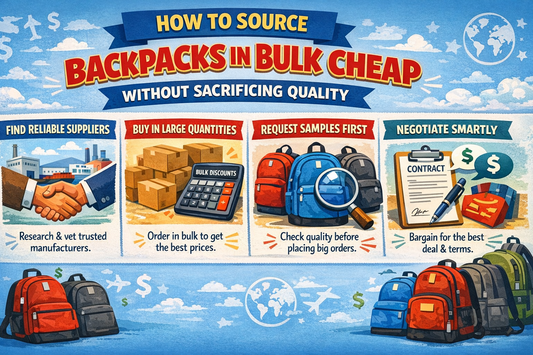
Before committing to bulk order, vet suppliers on these criteria:
Verify business registration and years in operation (minimum 3 years)
Request and verify 3+ customer references from bulk buyers
Order and inspect sample backpacks before bulk commitment
Review quality control documentation and testing procedures
Verify written return/replacement policy for defective goods
Confirm payment terms, currency, and wire transfer details in writing
Get complete shipping quote including all international fees
Test communication responsiveness (speed, clarity, language)
Review portfolio of past bulk orders and customization work
Confirm ability to scale up if your orders grow significantly
Inventory Management for Bulk Backpack Stock
Inventory Turnover Targets
Healthy inventory turnover ratio: Sell your entire inventory 3-4 times per year (every 3-4 months on average)
Why this matters: Inventory is capital. Money tied up in unsold backpacks doesn't generate profit. Fast turnover means money cycles back quickly, enabling reinvestment in more inventory or other business growth.
| Turnover Rate | What It Means | Impact | Action Needed |
|---|---|---|---|
| 1x per year | Inventory sits 12 months | Capital trapped; obsolescence risk | Reduce order size or increase marketing |
| 2x per year | Inventory sits 6 months | Slow moving; acceptable for some categories | Monitor closely; may indicate demand issue |
| 3-4x per year | Inventory sits 3-4 months | Healthy; capital cycles efficiently | Optimal target—maintain this level |
| 5-6x per year | Inventory sits 2 months | Fast moving; high demand | Consider increasing order size to capture more margin |
| 8+ per year | Inventory sits <6 weeks | Very fast moving; risk of stockouts | Increase order frequency to prevent being out of stock |
Tracking Inventory Performance
Track these metrics for each backpack SKU:
- Units sold per month: Calculate average monthly sales
- Days inventory on hand: How many days until current stock sells out?
- Inventory turnover ratio: Annual sales units ÷ Average inventory units = turnover rate
- Carrying cost per unit: Storage, insurance, handling cost per unit per month
- Profit per unit per month: Monthly gross profit ÷ average inventory
✓ Pro Approach: Use inventory management software (Shopify, TradeGecko, Cin7) to track these metrics automatically. Data-driven decisions replace guesswork.
Negotiating Better Bulk Pricing and Terms
Negotiation Leverage Points
You have negotiation power in these areas:
- Volume Commitment: "If I commit to 1,000 units annually, can you improve pricing?" Volume commitments give suppliers visibility and reduce risk
- Exclusive Distribution: "Will you grant me exclusive rights in my region?" Exclusivity is valuable to suppliers
- Payment Terms: "If I pay upfront, can you improve pricing 5%?" Upfront cash is extremely valuable to suppliers
- Customization Pricing: "If I order 800 units with custom colors instead of 500 standard, can you absorb customization setup fees?" Scale justifies concessions
- Seasonal Increases: "I'll order 200 units in slow season if you give me priority allocation during peak season." Demand smoothing helps suppliers with capacity planning
- Long-term Relationship: "I want to build a multi-year partnership. What can we do to make that mutually beneficial?" Suppliers value stability
- Competitive Quotes: Having 2-3 competing quotes creates healthy pressure (but don't over-use this)
What NOT to Negotiate
- Quality standards—never compromise on quality for lower price
- Lead times that put you at seasonal disadvantage
- Payment terms that expose you to fraud risk (full prepayment with unproven suppliers)
- Minimum order quantities beyond your capacity to absorb
- Reliability commitments—if supplier can't guarantee production timelines, walk away
Risk Management for Bulk Backpack Purchases
Key Risks and Mitigation Strategies
| Risk | Impact | Mitigation Strategy |
|---|---|---|
| Quality Issues | Damaged reputation, returns, discounting | Sample inspection, quality agreements, defect documentation |
| Delayed Delivery | Miss seasonal peak, lose sales revenue | Multiple suppliers, safety stock, buffer lead time in planning |
| Supplier Failure | Inability to fulfill orders to customers | Backup suppliers, written agreements, reliability tracking |
| Demand Miscalculation | Dead inventory, capital tied up, obsolescence | Conservative forecasting, start small, data-driven decisions |
| Currency Fluctuation | International order costs change unexpectedly | Lock pricing in USD, currency forward contracts for regular orders |
| Payment/Fraud Risk | Loss of capital if supplier is fraudulent | Escrow services, letters of credit, partial prepayment terms |
| Overstocking | Excess inventory reduces margin, wastes capital | Conservative order sizes, frequent reorders, tracking turnover |
Bulk Buying Mistakes to Avoid
Mistake #1: Ordering Too Much Too Soon
Biggest error: Betting entire year's budget on one large order. Better approach: Start with 25-50% of desired volume, prove the market, then increase future orders. Test products with small orders first.
Mistake #2: Ignoring Hidden Costs
Calculating ROI based only on unit price. Reality: Shipping, duties, inspection, and other costs often add 30-50% to landed cost. Always calculate complete landed cost before committing.
Mistake #3: Assuming Lead Times Are Flexible
Ordering late and expecting "rush delivery." Suppliers can't accelerate significantly without major cost increases. Plan 2-3 months ahead for international orders. Miss the window, miss the season.
Mistake #4: Trusting Single Suppliers
Relying entirely on one supplier for bulk orders. What happens when they fail to deliver? Maintain relationships with 2-3 suppliers. Risk diversification prevents catastrophic failures.
Mistake #5: Skipping Quality Inspection
Assuming sample quality = production quality. It doesn't. Manufacturer samples are hand-crafted and superior to bulk production. Inspect arrival shipments thoroughly before accepting.
Mistake #6: Overcommitting to Customization
Custom colors, logos, packaging look great but add cost and complexity. For first bulk order, stick with standard products. Prove sales, then expand to customization.
Bulk Backpack Buying Tools and Resources
Essential Tools for Bulk Buyers
📊 Supplier Comparison Spreadsheet
Track supplier details: contact, pricing at different volumes, MOQ, lead time, payment terms, customization options, references contacted, quality assessment. Compare 3-5 suppliers side-by-side.
💰 Cost Calculator
Build spreadsheet calculating: unit price × volume + shipping + duties + inspection + insurance = total landed cost ÷ quantity = cost per unit. Test different volumes to find optimal tier.
📈 Inventory Tracking Software
Shopify, TradeGecko, Cin7, or similar platforms track: units in stock, units sold, turnover rate, days on hand, profit per unit. Data drives reorder decisions.
📅 Bulk Order Calendar
Map seasonal peaks and plan ordering accordingly. Back-to-school peaks July-August = order by May. Holiday gifts peak September-November = order by July. Calendar prevents last-minute rushes.
✅ Quality Inspection Checklist
Standardized checklist for inspecting bulk shipments: zippers, seams, material quality, color accuracy, packaging, count verification. Consistent quality standards prevent surprises.
📝 Supplier Agreement Template
Written agreement covering: pricing, MOQ, lead time, payment terms, quality standards, return policy, communication expectations, exclusivity terms (if applicable). Protects both parties.
Case Study: Retail Store's Bulk Purchasing Strategy
The Scenario
Sarah opens a sports retail store. Initially buys backpacks individually at $35-40 each. Realizes margins are 20-30% and inventory is limited.
The Shift to Bulk Buying
Sarah researches wholesale suppliers, identifies 3 regional distributors, and commits to quarterly bulk orders of 150-200 units at $14-16 per unit.
Results After Year 1
- Total bulk orders: 600 units at average $15/unit = $9,000 investment
- Retail price: $45-55 depending on style
- Average gross profit: $25 per unit × 600 units = $15,000
- Inventory turnover: 3.2x per year (healthy)
- Margin improvement: from 25% to 56% (124% increase)
- Profit improvement: from $2,000 (at 20% margin on retail purchases) to $15,000 (56% margin on wholesale)
- Competitive advantage: Can undercut competitor prices by 10-15% while maintaining superior margins
Year 1 Impact: Additional $13,000 profit from switching to bulk buying. Investment justified within 2 months.
Year 2-3 Growth
- Increased to 1,000+ annual units
- Negotiated exclusive regional distribution with supplier
- Introduced private-label "Sarah's Sports" branded backpacks
- Opened second store location leveraging established supplier relationships
- Per-unit cost dropped to $12-13 through volume and loyalty discounts
- Annual gross profit exceeded $25,000
The Bottom Line: Bulk Buying Is Strategic Business
Buying backpacks in bulk transforms from a simple purchasing decision into a strategic business process. Understanding volume tiers, calculating true landed costs, vetting suppliers, planning inventory strategically, and managing risk separates profitable retailers from those constantly struggling with margins and cash flow.
The economics are undeniable: bulk buyers access 50-70% cost savings versus retail purchasing. That advantage translates directly to higher margins, competitive pricing power, and sustainable profitability. For retailers, corporate buyers, and institutional purchasers, mastering bulk backpack buying is essential to operational success.
Start with research. Vet suppliers thoroughly. Begin with small orders (200-300 units) to test the market and build supplier relationships. Track inventory religiously. Scale gradually as you gain experience and capital. This systematic approach converts wholesale purchasing from a gamble into a reliable competitive advantage.
Your bulk backpack buying strategy doesn't begin with finding the cheapest supplier—it begins with understanding your business needs, calculating true ROI, and building reliable supplier partnerships. That foundation generates profit for years to come.
Previous
How to Buy Wholesale Backpacks for Retail in 2026
Next
Custom Backpack Wholesale: How to Brand Bags for Your Business