Backpacks are one of retail's quietly reliable categories: practical, repeat-purchase, gift-friendly and seasonally resilient. But buying them in bulk well takes more than picking what looks good. Here's a practical framework for retailers and resellers.
Start here: Don't buy products, buy for a customer. Define who you serve first, and every other decision (styles, price points, quantities) gets easier.
Why backpacks are a strong category
Demand is steady year-round and spikes around back-to-school, holidays and travel seasons. Bags also lend themselves to add-on and gift purchases, and feature-rich models (anti-theft, USB) command higher margins than plain ones.
Build a balanced assortment
A focused, layered range outsells a scattered one. Cover the core needs:
- Everyday laptop backpacks: your volume sellers.
- Anti-theft & USB models: strong demand and better margins.
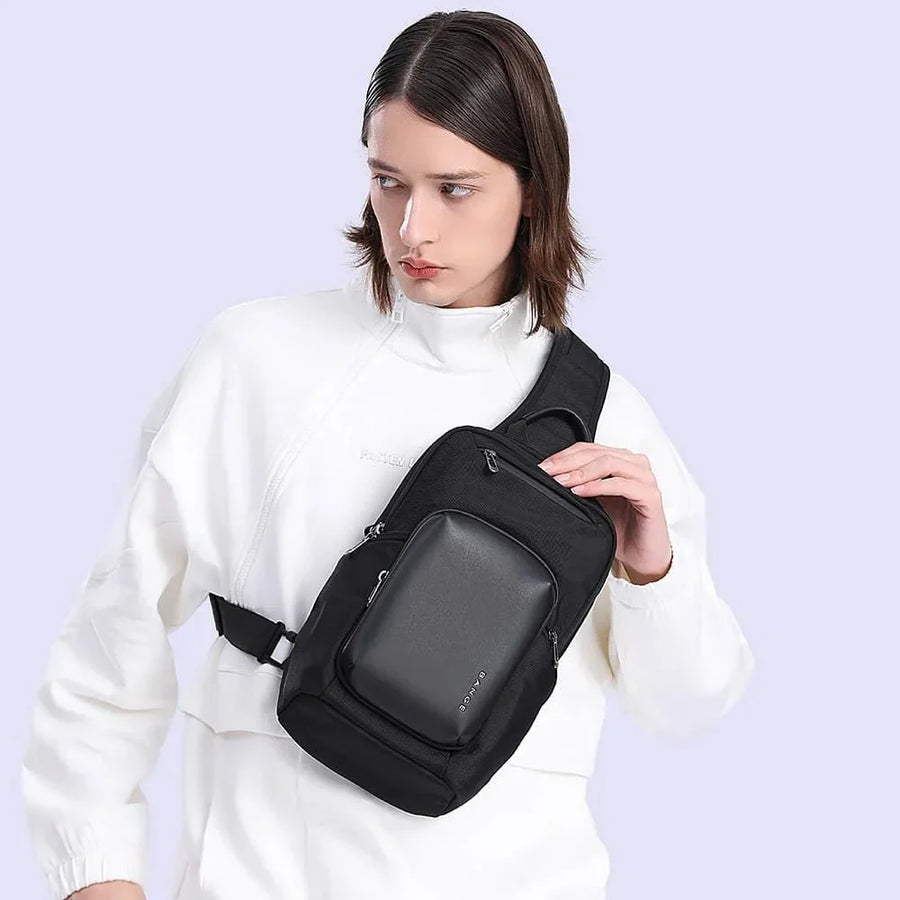
- Slings & crossbody bags: affordable impulse and add-on buys.
- Travel & expandable: higher ticket, seasonal lift.
Choosing the right fabric
Fabric weight is one of the biggest quality signals in a bulk order. Thin 210D nylon is common in the cheapest bags and shows wear fast. A better standard for durable, water-resistant bags at a reasonable cost is 600D polyester or Oxford fabric, which holds up to daily use without the price of premium ballistic nylon or leather.
Quality control checkpoints before you commit
Before finalizing a bulk order, request a sample and check:
- Stitching strength: look for double stitching on high-stress points like shoulder straps.
- Zipper durability: test for smooth operation. Zippers are usually the first part to fail on low-cost bags.
- Interior lining: a thick, well-finished lining protects contents and adds structure to the bag.

Know your numbers
Profit lives in the math, not the invoice price. Always calculate landed cost (unit price plus shipping, duties/taxes and fees) before setting retail. Bags commonly support healthy markups (often 2-3x), but confirm yours after landed cost, not before. Ladder good-better-best within each category so shoppers can trade up.
Order in tiers and test
Resist the urge to go deep on day one. Start with moderate quantities of proven styles, learn what sells through, then reorder winners with confidence. This protects cash flow and keeps you from sitting on slow movers.
Quality protects your brand
Returns and bad reviews erode margins faster than any discount. Prioritize durable, high-denier fabrics, quality (YKK-style) zippers and consistent stitching, and request samples before committing to volume. The bag carries your reputation, whether it's branded or your own label. A proven starting point is the Bange Solix 1801 Laptop Backpack, a 1680D waterproof, anti-theft design retailers reorder often.

Plan logistics early
Understand the supplier's minimum order quantities (MOQs), lead times and shipping terms up front so stock lands before demand peaks. (We break these down in our wholesale logistics guide.)
How to Calculate ROI on Bulk Backpack Purchases
Work this out for each model before you order, using your supplier's quote, your local prices and your own sales history.
1Landed cost per unit
Unit price plus freight, duties, customs clearance and any inspection fees, divided by the number of units. If the supplier quotes DDP, most of this is already in the price.
2Retail price
Check what similar bags sell for in your market, not what you would like to charge.
3Gross profit per unit
Retail price minus landed cost per unit.
4Sales per month
Use your own sales of similar products. If you have no history yet, start with a low estimate.
5Break-even point
Divide the total cost of the order by the gross profit per unit to get the units you must sell to break even. Divide that by monthly sales to get the months it takes.
6Annual return
Multiply the units you expect to sell in a year by the gross profit per unit, subtract the total cost of the order, then divide by the total cost of the order.
If break-even is more than a season away, order fewer units or fewer colours, and reorder once you know what sells.

Negotiating Better Bulk Pricing and Terms
Negotiation Leverage Points
You have negotiation power in these areas:
- Volume Commitment: "If I commit to 1,000 units annually, can you improve pricing?" Volume commitments give suppliers visibility and reduce risk
- Exclusive Distribution: "Will you grant me exclusive rights in my region?" Exclusivity is valuable to suppliers
- Payment Terms: "If I pay upfront, can you improve pricing 5%?" Upfront cash is extremely valuable to suppliers
- Customization Pricing: "If I order 800 units with custom colors instead of 500 standard, can you absorb customization setup fees?" Scale justifies concessions
- Seasonal Increases: "I'll order 200 units in slow season if you give me priority allocation during peak season." Demand smoothing helps suppliers with capacity planning
- Long-term Relationship: "I want to build a multi-year partnership. What can we do to make that mutually beneficial?" Suppliers value stability
- Competitive Quotes: Having 2-3 competing quotes creates healthy pressure (but don't over-use this)
What NOT to Negotiate
- Quality standards: never compromise on quality for lower price
- Lead times that put you at seasonal disadvantage
- Payment terms that expose you to fraud risk (full prepayment with unproven suppliers)
- Minimum order quantities beyond your capacity to absorb
- Reliability commitments: if a supplier can't guarantee production timelines, walk away

Risk Management for Bulk Backpack Purchases
Key Risks and Mitigation Strategies
| Risk | Impact | Mitigation Strategy |
|---|---|---|
| Quality Issues | Damaged reputation, returns, discounting | Sample inspection, quality agreements, defect documentation |
| Delayed Delivery | Miss seasonal peak, lose sales revenue | Multiple suppliers, safety stock, buffer lead time in planning |
| Supplier Failure | Inability to fulfill orders to customers | Backup suppliers, written agreements, reliability tracking |
| Demand Miscalculation | Dead inventory, capital tied up, obsolescence | Conservative forecasting, start small, data-driven decisions |
| Currency Fluctuation | International order costs change unexpectedly | Lock pricing in USD, currency forward contracts for regular orders |
| Payment/Fraud Risk | Loss of capital if supplier is fraudulent | Escrow services, letters of credit, partial prepayment terms |
| Overstocking | Excess inventory reduces margin, wastes capital | Conservative order sizes, frequent reorders, tracking turnover |
Bulk Buying Mistakes to Avoid
Mistake #1: Ordering Too Much Too Soon
Biggest error: Betting entire year's budget on one large order. Better approach: Start with 25-50% of desired volume, prove the market, then increase future orders. Test products with small orders first.
Mistake #2: Ignoring Hidden Costs
Calculating ROI based only on unit price. Reality: Shipping, duties, inspection and other fees all sit on top of the unit price. Always calculate complete landed cost before committing.
Mistake #3: Assuming Lead Times Are Flexible
Ordering late and expecting "rush delivery." Suppliers can't accelerate significantly without major cost increases. Plan 2-3 months ahead for international orders. Miss the window, miss the season.

Mistake #4: Trusting Single Suppliers
Relying entirely on one supplier for bulk orders. What happens when they fail to deliver? Maintain relationships with 2-3 suppliers. Risk diversification prevents catastrophic failures.
Mistake #5: Skipping Quality Inspection
Assuming sample quality = production quality. It doesn't. Manufacturer samples are hand-crafted and superior to bulk production. Inspect arrival shipments thoroughly before accepting.
Mistake #6: Overcommitting to Customization
Custom colors, logos, packaging look great but add cost and complexity. For first bulk order, stick with standard products. Prove sales, then expand to customization.

Frequently asked questions
How many styles should I start with?
Enough to cover your core customer's needs, often 4-8 well-chosen SKUs, rather than a broad, unfocused range.
What margin should I expect on backpacks?
Many retailers target roughly 2-3x landed cost, but always price from your true landed cost and local market.
Should I request samples?
From most suppliers, yes. At BANGE, a sample is paid, with shipping included, and the cost is usually deducted from your bulk order when you go ahead.
Is it cheaper to buy directly from a manufacturer?
Usually, yes. Cutting out middlemen reduces markup and gives you more control over production quality, though it typically means higher minimum order quantities and longer lead times than buying from a domestic distributor.
The bottom line
Buy for a defined customer, build a balanced and laddered assortment, choose fabric quality that matches your price point, price from landed cost, and test before you scale. Explore the Bange range of proven, feature-rich sellers and reach out to discuss wholesale terms.
Previous
Wholesale Backpack Brands vs Manufacturer-Direct: How to Choose (2026)
Next
Private-Label vs Branded Backpacks: Which Is Right for Your Store?